SE Ranking
Is AI Mode Now Dominated by Google's Self-Referencing Links?
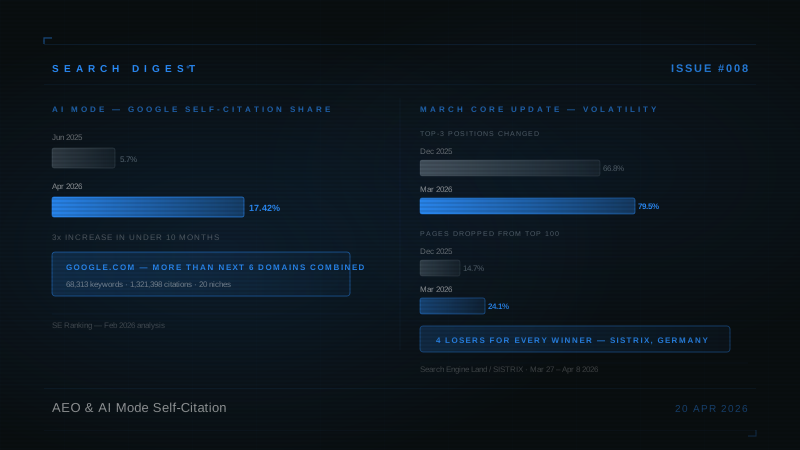
SE Ranking analysed 68,313 keywords across 20 niches and collected 1,321,398 citations from Google's AI Mode. Google.com is the single most-cited domain at 17.42% of all responses, more than the next six domains combined. That share has tripled since June 2025, when it sat at 5.7%. The composition has also shifted: previously, 97.9% of Google's self-citations pointed to Google Business Profiles. Now only 36.1% do, while 59% point to organic search result pages. Google is using AI Mode to send users back into its own search funnel, not just to local listings.
The niche data makes the pattern even clearer. Google ranks as the top-cited source in 19 of 20 niches analysed. The highest self-citation rates appear in Travel at 53.18%, Entertainment at 48.74%, and Real Estate at 30.54%. For anyone doing GEO work in those verticals, Google's own properties are now a significant competitor for AI Mode citation slots. The study does not cover what Google will cite if its own properties are unavailable, but the direction of travel is clear: Google is building AI Mode into a closed loop that favours its own ecosystem.
Key points
- Google.com accounts for 17.42% of all AI Mode citations, up from 5.7% in June 2025, a 3x increase in under 10 months
- Google is cited more than the next six domains combined across the full dataset of 1.3 million citations
- Citation type shifted from Google Business Profiles (97.9%) to organic SERPs (59%), routing users back into traditional search
- Google is the top-cited source in 19 of 20 niches, with Travel (53.18%), Entertainment (48.74%), and Real Estate (30.54%) highest
- 68,313 keywords analysed across 20 niches using SE Ranking's AI Mode Tracker
Key takeaway
If you are building a GEO strategy for Travel, Entertainment, or Real Estate, you are now competing directly with Google's own properties for AI Mode citation slots. That changes the calculus significantly: optimising for AI citations in those niches is not just about outperforming other publishers, it is about being cited in the slots Google does not fill with its own results. Knowing which niches have lower Google self-citation rates helps you prioritise where the GEO opportunity is actually open.
Also worth considering
The shift from Business Profile citations to organic SERP citations is worth watching closely. If Google is directing AI Mode users back to search result pages, it is preserving the search session and the ad inventory that comes with it. That is a commercial decision as much as a product one, and it suggests AI Mode is being designed to support Google's search business rather than replace it.
What I'm testing
Checking which niches in my own work have the lowest Google self-citation rates in AI Mode, since those are the verticals where external content has the best chance of appearing. Running queries in AI Mode for target topics and recording whether Google properties dominate the citations or whether third-party sources get meaningful slots.