Daniel Shashko / Bright Data (via Chris Long)
AI Mode's Hidden #:~:text Fragment Reveals Exactly How It Chooses What to Cite
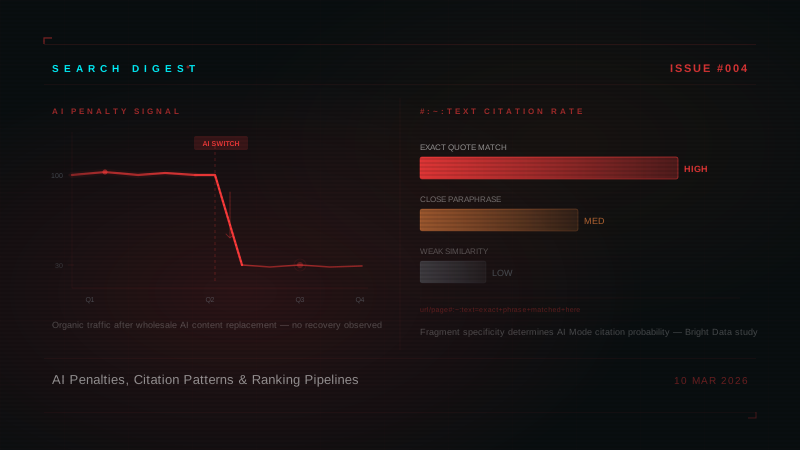
Daniel Shashko at Bright Data had the insight to extract and analyse the #:~:text fragment that appears in AI Mode citation URLs, the hidden parameter that records exactly which sentence from a page the AI selected. By pulling this from 13,000 citations across 500+ queries, he built a dataset that shows not just what gets cited but where on the page it sits, how long the sentence is, and what structural properties it has. Chris Long, who flagged this in his newsletter, described it as the study he had been waiting for someone to run.
The findings confirm and sharpen the patterns from Kevin Indig's earlier citation research. The mean position of cited content is 34% down the page, consistent with front-loaded content getting more citation weight. The mean cited sentence is 9.8 words. Sentences between 6-20 words account for 92% of all citations. That is not a coincidence, it is a structural preference for concise, declarative statements over long, qualified ones. And 95% of cited pages had at least one structured element: a list, table, or heading.
Key points
- 71% of AI Mode results included a #:~:text fragment, confirming AI Mode records the specific sentence it drew from for the majority of citations
- Mean cited content position: 34% down the page, reinforcing that early-page content has significantly higher citation probability
- Mean cited sentence length: 9.8 words, sentences between 6-20 words account for 92% of all citations
- 95% of cited pages contained at least one structured element, a list, table, or heading, as the most common structural marker
- 98% of pages with structured elements used an ordered or unordered list, making lists the single structural element most strongly linked to being cited
Key takeaway
Write sentences that can stand alone as facts. If a sentence requires the previous sentence to make sense, it is not structured for AI citation. Aim for the 6-20 word range for key claims and definitions, place them in the first third of the page, and follow them with a supporting list or structured breakdown. That is the citation-friendly pattern this data points to.
Also worth considering
The structured element finding is one of the strongest signals in this dataset. 95% of cited pages had at least one list, table, or heading, and the list correlation is near-universal. If your content is almost entirely prose without structure, you are competing at a disadvantage regardless of how good the writing is. Structure and content quality are not in tension here; both matter.
What I'm testing
Auditing the sentence length distribution on several pages that rank well but are not appearing in AI Mode citations. Looking for clusters of long, qualified sentences in the first 35% of each page and rewriting them as shorter, standalone factual statements.